
Oliver’s Island
Oliver’s Island, Hounslow
A small Thames island lying off Strand on the Green
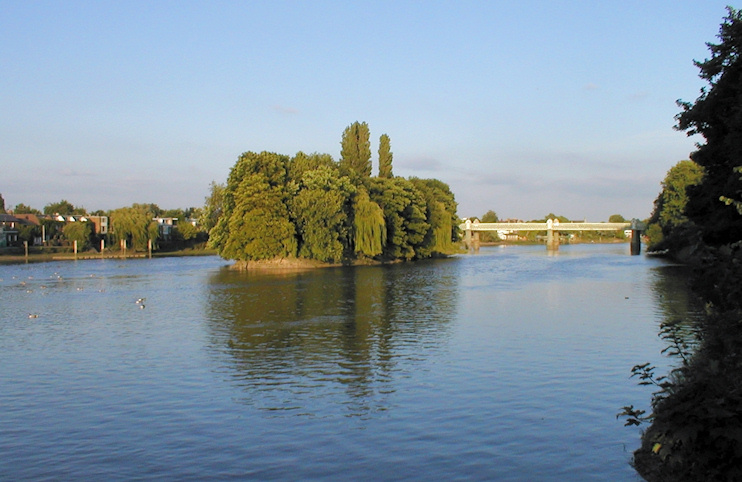
The island’s name derives from the story that Oliver Cromwell once took refuge here but there is almost certainly no truth in this. It was called Strand Ayt until a century after the Civil War, by which time the myth had arisen that Cromwell had used the Bull’s Head in Strand on the Green as an intermittent headquarters. The story was further embellished with suggestions of a secret tunnel connecting the inn and the island, allegedly constructed to help Catholic priests escape Protestant persecutors.
From the late 18th century Oliver’s Island had a kind of tollbooth, a wooden structure shaped like a small castle, which levied charges on passing craft to fund improvements to the river’s navigability. A barge was moored alongside, from which the tolls were taken. By 1865 there was a smithy and barges were built and repaired here. In 1909 the Thames Conservancy assigned Oliver’s Island to the Port of London Authority (PLA), which used it as a storage depot and as a wharf for derelict vessels.
In 1958 the residents of Strand on the Green formed an amenity group for their locality, which also took an interest in conservation on the island.
The Strand on the Green Association was at the forefront of a successful campaign of resistance when the PLA tried to sell the island in 1971. The smithy was demolished in 1990. The thickly wooded island is now a haven for herons, cormorants and Canada geese. Efforts have been made to control non-native tree and bird species.
Postal district: W4