
Fitzrovia
Fitzrovia, Westminster/Camden
From the 1930s (or perhaps a little earlier) the area between Fitzroy Square and Oxford Street became known to its denizens as Fitzrovia
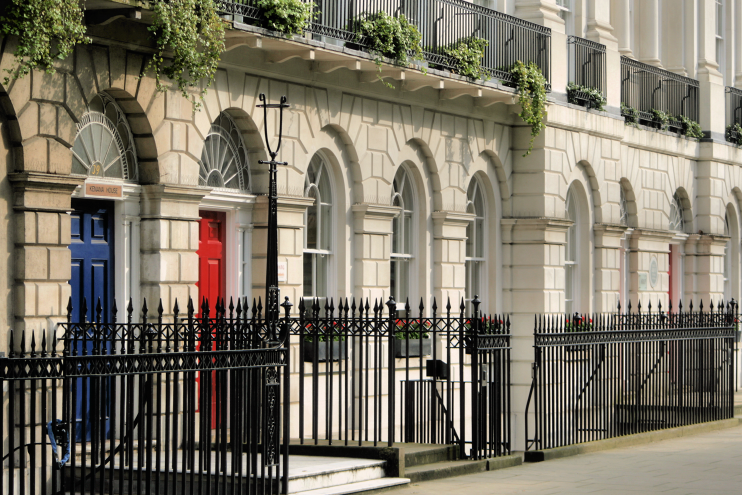
The locality was first developed by Charles Fitzroy, lord of the manor of Tottenhall, from 1757. The east and south sides of Fitzroy Square were designed by Robert Adam in 1794 and survive in their original form, in Portland stone, though with extensive restoration of wartime damage on the south side (shown in the photograph above).
Fitzroy built for the upper classes, but they soon migrated south-westwards to Belgravia and Mayfair, forcing subdivision of the aristocratic houses into workshops, studios and rooms to let.
Immigrants from France and neighbouring countries crowded in and helped establish the district as a centre for the furniture trade by the end of the 18th century. Thomas Chippendale was among the craftsmen who set up shop here. The artist John Constable maintained a local residence, although he spent most of his time in Hampstead.
Early in the 20th century Walter Sickert and friends formed the Fitzroy Street Group, based in Whistler’s former home at 8 Fitzroy Street.
In the mid to late 1930s Augustus John and Dylan Thomas bolstered the Bohemian reputation of the area north of Oxford Street – which was regarded by many at that time as a northern extension of Soho.
John is widely said to have invented the ‘Fitzrovia’ name, in honour not of Fitzroy Square but of his favourite hostelry, the Fitzroy Tavern. However, in his excellent book London Calling, local resident Barry Miles credits the coinage to the Ceylonese publisher and editor Meary J Tambimuttu, with the same boozy inspiration.
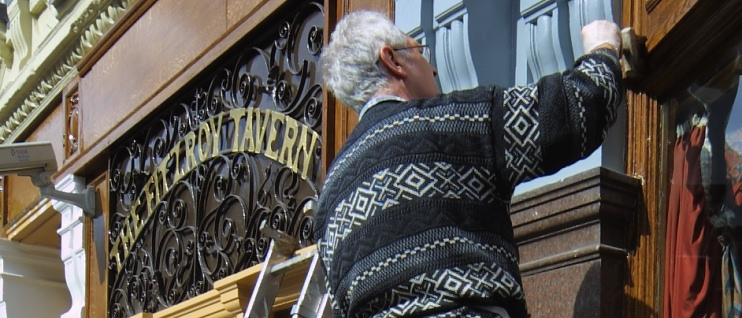
But it’s possible that neither version of this romanticised story is true. Hidden London believes that the term ‘Fitzrovia’ may have been in use by the late 1920s, based on a reference in a 1930 book review* to “Miss Hamnett’s reminiscences of Montparnasse and that district of London which is sometimes known as Fitzrovia.” Nina Hamnett’s memoirs do not mention the Fitzrovia locality by that name, so this review seems to constitute its first ever appearance in print. In the late 1920s none of the people usually credited with inventing the name were yet frequenting the locality, except possibly Tom Driberg, and he didn’t use the ‘Fitzrovia’ appellation in his newspaper column until 1940.
Before the Second World War Fitzrovia had a highly visible German community and Charlotte Street – the principal thoroughfare – was nicknamed Charlottenstrasse. Greeks and Italians brought new vitality to the locality after the war, followed later by Nepalese and Bengalis.
A post-war shortage of commercial space in central London prompted the rezoning of Fitzrovia as a light industrial area and some fine Georgian properties – including Constable’s house – were knocked down and replaced by office blocks, many of which have since been rebuilt.
Located at 60 Cleveland Street, the BT Tower was built for the General Post Office and became operational on 8 October 1965. The tower is 174 metres tall – 189m to the top of its highest mast – and was the UK’s tallest building from its topping out until 1980.
 Following residents’ pressure, Fitzrovia’s name appeared for the first time on Ordnance Survey maps in 1994. Equally diligent efforts later succeeded in defeating property developers’ misguided attempts to rebrand the area ‘Noho’.
Today, around 6,500 people live in Fitzrovia, while 50,000 work here. Charlotte Street is a focus for media businesses – and for their favourite bars and bistros.
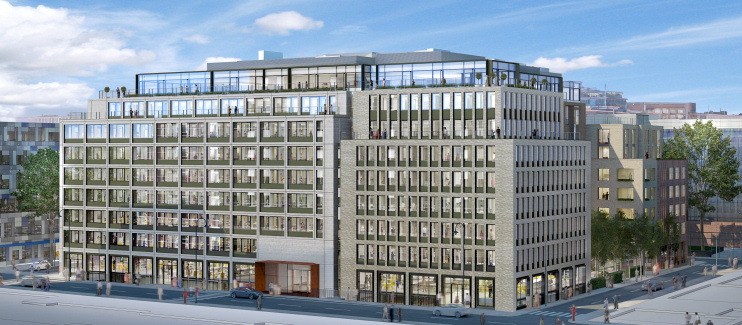
The latest big projects in Fitzrovia have been the redevelopments of the former Royal Mail site between Rathbone Place and Newman Street and the former Saatchi & Saatchi offices in Charlotte Street. Rathbone Square has 162 apartments, Facebook’s new UK headquarters and shops, cafés and restaurants around a new public square. Shown in the developers’ CGI below, 80 Charlotte Street is also a mixed-use scheme with a new public space. The building’s design is said to be a homage to the constructivist artists who lived in Fitzrovia in the 1950s and 60s.
George Bernard Shaw lived with his mother at 37 Fitzroy Street in the early 1880s and then in Fitzroy Square from 1887 until his marriage in 1898. The former address was the London base of the writer – and founder of Scientology – L. Ron Hubbard in the 1950s. The house now hosts an exhibition of Hubbard’s life and work, and is open to the public by appointment.
Postal districts: W1 and WC1 (the WC1 part is Fitzrovia’s “Gower Peninsula” between Tottenham Court Road and Gower Street)
Station: Northern line (Goodge Street, zone 1)
Further reading: Brian Girling, Bloomsbury & Fitzrovia Through Time, Amberley, 2012
and Ann Basu, Fitzrovia, The Other Side of Oxford Street: A Social History , The History Press, 2019
Further viewing: Paolo Sedazzari’s evocative and informative short film Viva Fitzrovia
Website: Fitzrovia News