
Clissold Park
Clissold Park, Hackney
A much-loved 55-acre park located in north-west Stoke Newington
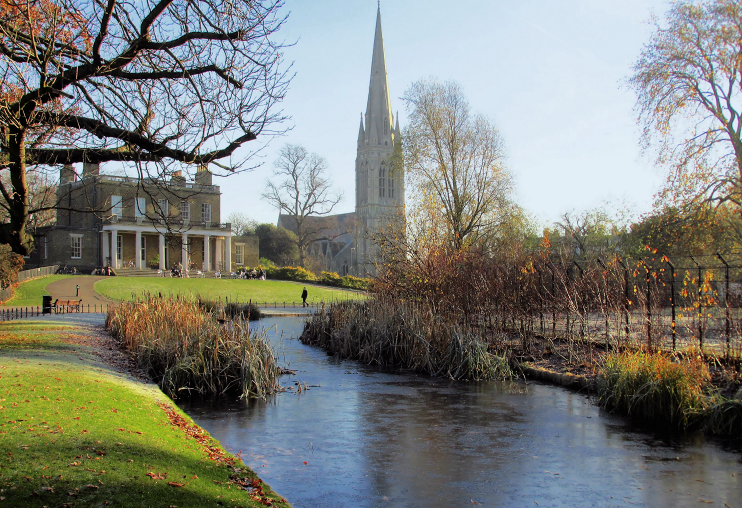
In 1790 the Quaker banker Jonathan Hoare commissioned his nephew Joseph Woods to build a mansion here, demolishing four houses on the north side of Church Street in the process. Brick earth was excavated in the grounds, leaving two depressions that were later made into ornamental lakes. Hoare had previously lived across the road on Paradise Row and called his new home the Paradise House. Within ten years financial difficulties forced him to move out and in 1811 the estate was sold to the Crawshay iron-making family.
Eliza Crawshay inherited the property on her father’s death in 1835, when she married the Reverend Augustus Clissold. The couple had previously been conducting a secret affair that had allegedly prompted Eliza’s father to build a high wall around the estate to keep out the lovelorn parson.
From the mid-19th century streets began to be laid out on former glebe land to the south. One of the first was Park Road, now Clissold Road.
After the death of Augustus Clissold in 1882 the Ecclesiastical Commissioners bought the estate with the intention of profiting from a property development scheme. However, this was a time of popular and municipal zeal for public open spaces and the Metropolitan Board of Works bought the house and grounds in 1887 for the creation of Clissold Park. Joseph Beck and John Runtz were leading proponents of the purchase and the twin lakes were named Beckmere and Runtzmere in their honour.
The park was endowed with a lodge soon after it opened but this was replaced in 1936 by the flats of Clissold Court.
2012 saw the completion of a major restoration and development project that included the renovation of Clissold Mansion and the bowling pavilion, the reinstatement of a section of the New River and the restoration of lost paths and vistas.
At the north-west corner of the park a large section of Hackney’s Kings Crescent estate has recently undergone radical redevelopment as the Clissold Quarter.
Postal district: N16
Population: 12,212 (Clissold ward, 2011 census)
Further reading: David Solman, Clissold Park, Abney Park Cemetery Trust, 1992
Website: Clissold Park User Group