Index of Places The 350 localities and attractions featured on Hidden London The places listed below are in the Gazetteer section unless marked as being in The Guide Places in the Gazetteer section are mostly localities, while those in the Guide tend to be smaller – often an individual structure. Some places in the Guide are double-indexed, to help you find them more easily. A few listed places have yet to be added, so they don’t yet have a h…
Alexandra Palace, Haringey North London’s answer to the Crystal Palace crowns the 313-foot summit of Muswell Hill, west of Wood Green At the end of the 1850s the Great Northern Railway Company opened Wood Green (now Alexandra Palace) station and the Great Northern Palace Company acquired Tottenham Wood Farm. The latter company opened a pleasure garden and then reused materials from the international exhibition held at South Kensington in 18…
Turnpike Lane, Haringey A tube station and locality at the southern tip of Wood Green, taking its identity from the road that runs west towards Hornsey Like much of this swathe of Haringey, the Turnpike Lane locality has a significant Turkish community Turnpike Lane branches westward from the point where Wood Green High Road meets Harringay’s* Green Lanes. It was formerly called Tottenham Lane, as it still is further to the south-west. In th…
…’s cat. From the late 16th century a ribbon of houses began to form along Highgate Hill. The settlement was split down the middle between the parishes of St Pancras and Hornsey, as it now is between the boroughs of Camden and Haringey. The much-altered Lauderdale House was a home of Charles II’s mistress Nell Gwynne. The Flask public house dates from 1663. From the late 17th century to the end of the 18th century Highgate filled with smart hous…
Crouch End, Haringey A fashionable Victorian suburb centred around a confluence of routes a mile south-west of Hornsey Crouch End clocktower The name is of Middle English origin, an ‘end’ being an outlying place, while a ‘crouch’ was a cross, which may have been placed here as a boundary post between two manors. During the late 18th century the village took shape as a congregation of labourers’ cottages, though there were grander houses in th…
Cranley Gardens, Haringey A hillside residential locality in southern Muswell Hill, centred on the dog-legged avenue of the same name and overlooked by Queen’s Wood 23 Cranley Gardens, the former home of serial killer Dennis Nilsen The Imperial Property Investment Company bought farmland here from the Ecclesiastical Commissioners and built the first houses in Cranley Gardens and Onslow Gardens in the 1890s. Lack of interest from potential…
Manor House, Hackney/Haringey A London Underground station, and by extension its immediate vicinity, located at the eastern corner of Finsbury Park The Manor House pub sign, set into the wall of what is now a supermarket Before the creation of Seven Sisters Road, and thus of the rossroads, this was the site of a tollgate on Green Lanes. The Manor Tavern was built here in 1832 by Thomas Widdows of Church Street, Stoke Newington, who was allege…
Stroud Green, Haringey/Islington ‘An interesting, not very well known, Victorian urban landscape’, according to local historian Ken Gay, situated north of Finsbury Park station and south of Hornsey Vale Stapleton Hall Stroud Green’s name is of 15th-century origin and indicated a marshy place overgrown with brushwood. The first large building here was Stapleton Hall, which was built in 1609 for Sir Thomas Stapleton, possibly on the site of a…
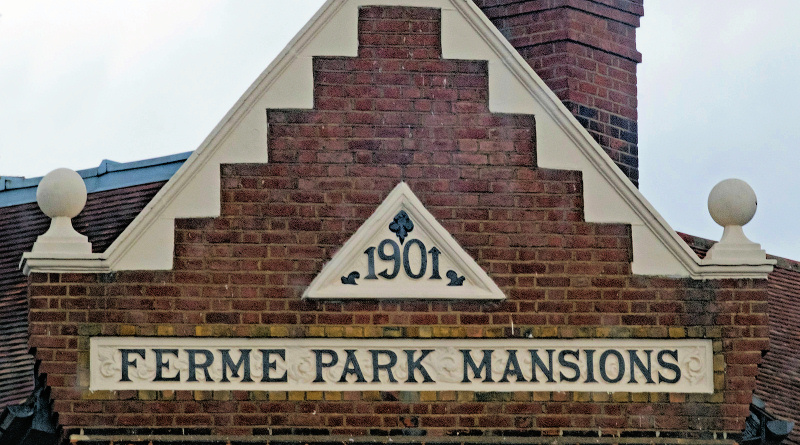
Hornsey Vale, Haringey A family-friendly corner of Hornsey, merging with Crouch End to the west of Ferme Park Road Mount View Road, Hornsey Vale Until the late 1870s the ridge running across the district was known as the Hog’s Back and its slopes consisted of farmland with just a few mansions, including Womersley House, the home of Oxford Street retailer Peter Robinson. Within the space of a few years the large houses were bought up and repla…
Bruce Grove, Haringey A station and street in central Tottenham, with nearby Bruce Castle as the principal place of interest The main entrance and clocktower of Bruce Castle The Bruce family built Tottenham manor house here in the mid-13th century but Edward I sequestered their property after Robert the Bruce rebelled and became king of Scotland in 1306. The house was rebuilt in 1514 on a scale that would befit visits from Henry VIII and Eliz…